Giving Innovation Room To Fight | Haworth Panel
 Read Below
Read Below
Read Below
Giving Innovation Room To Fight | Haworth Panel
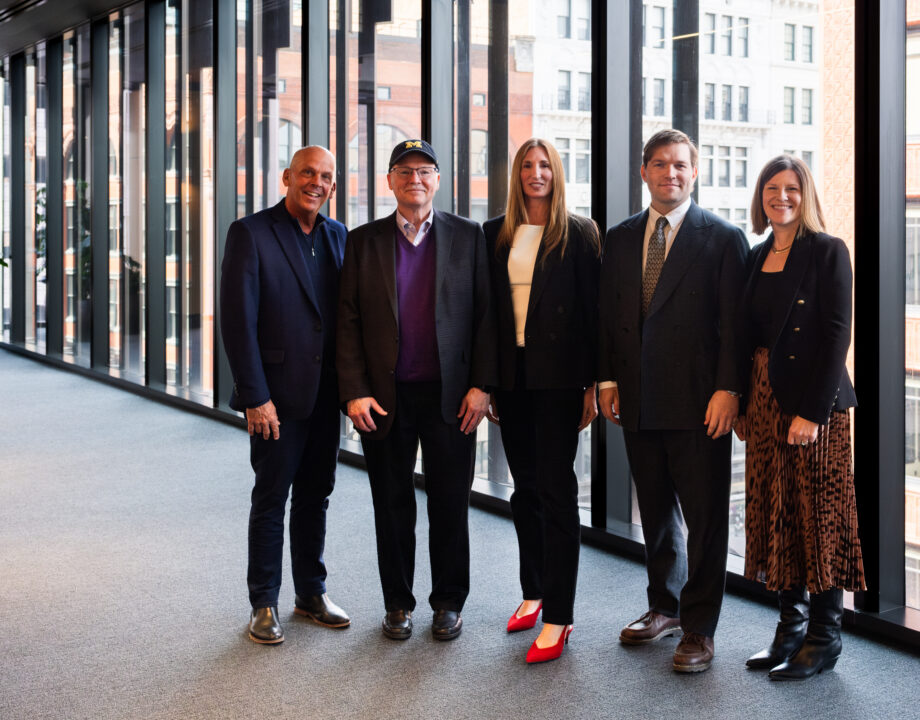
What does it take to get people excited about coming to the office? Not mandates. Not policies. Great design. That was one of the central ideas that emerged from Giving Innovation Room to Fight, a panel conversation hosted by Haworth that brought together some of the city’s most forward-thinking voices; Jeff DeGraff from University of Michigan, Michael Harrison from Bedrock, Pamela Jamieson from General Motors, and Jennifer Janus, our President. The discussion was grounded in real projects, real challenges, and a deep love for Detroit. The panelists made one thing abundantly clear: in today’s world of hybrid work and endless optionality, design is the foundational strategy of a strong modern workplace.
“We know return to work mandates haven’t been successful for companies…” Jennifer said plainly. “Draw people in, and they will come.”
When asked about our approach to innovation in design, Jennifer emphasized that we don’t lead with trends, we lead with curiosity.
“We’ve really tried to focus on creating spaces where they’re flexible and adaptable to what that team needs,” Jennifer explained. “You need to understand what is that team trying to accomplish? What are the problems they’re trying to solve? And then create spaces that support change over time.”
Strategy is at the heart of how Pophouse approaches every commercial interior design project. Office environments have changed dramatically over the past several years. No one fully knows what the future of work looks like, but we do know that the best spaces are the ones that are ready for whatever comes next. That means weaving together spaces that offer room for focused individual work, dynamic collaboration, and genuine wellness, all within environments that give people permission to step away, recharge, and come back energized. Jeff encapsulated the thesis of innovation in design with this simple statement: “Innovation is the product of creativity, and creativity requires energy”. Hudson’s Detroit was tasked with generating that energy for both the community and commercial tenants.

Much of the panel’s conversation centered on one of Bedrock’s most ambitious projects: the redevelopment of the former Hudson’s site, now a landmark mixed-use commercial development. Pophouse was deeply embedded in the design process over the last five years, working in close partnership with Bedrock and SHoP Architects on the building’s atrium and amenity spaces.
“There’s so much more choice and flexibility,” Jennifer noted, “and people really having say over the way they like to work. There has to be amenity spaces that draw people in — that get them excited to leave home and to come to the office.”
The shared-amenity model, where multiple companies under one roof benefit from communal, high-quality spaces, is a hospitality design principle proving to be exactly what tenants want. The fifth-floor atrium became the anchor for this vision, a light-filled, biophilic space designed to balance cutting-edge technology with the calmness of nature. The atrium was conceived as a space for unexpected collisions, a place where tenants from different companies could meet, interact, and spark ideas that no one planned.
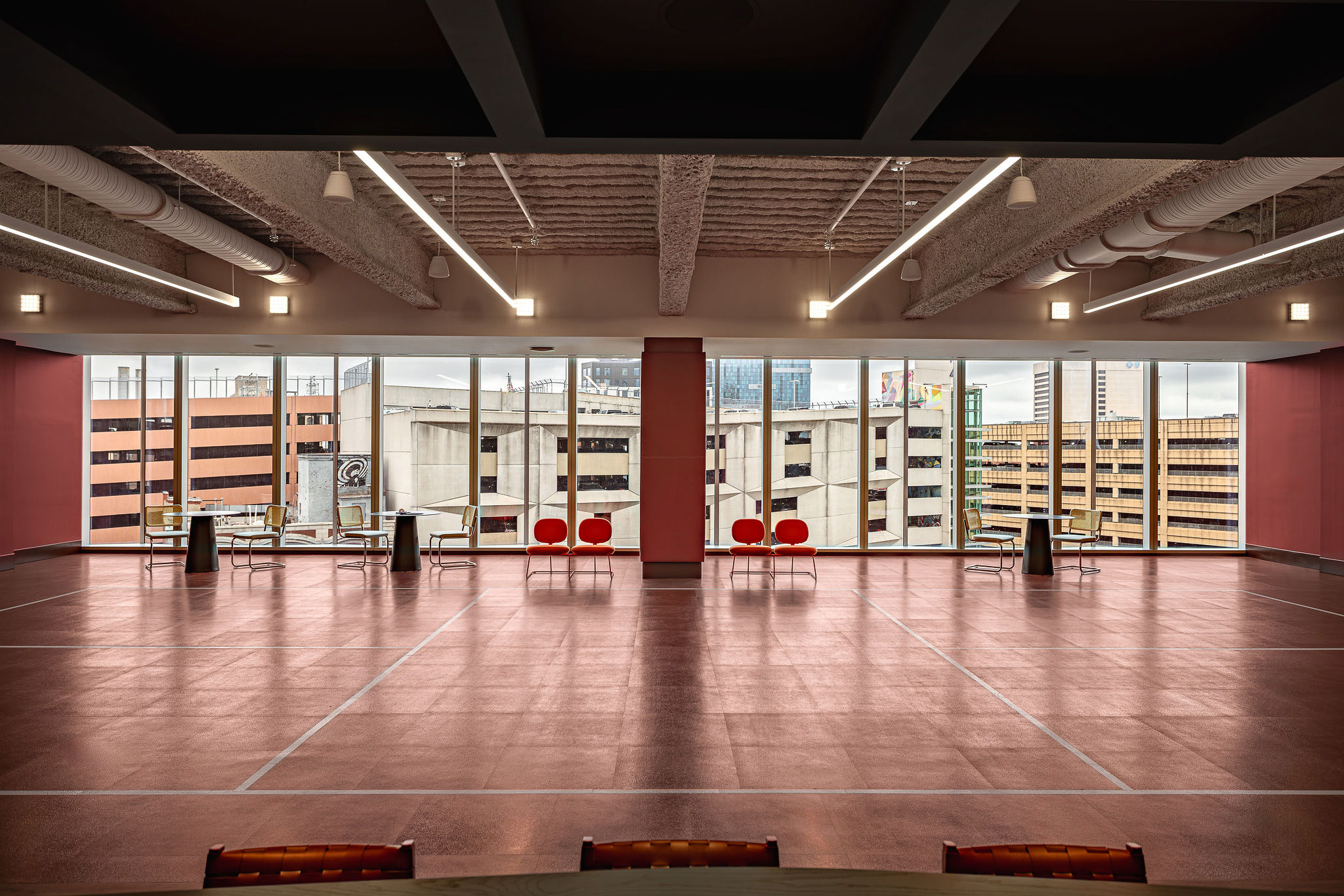
Designed during the height of the return-to-work crisis, the building’s 100,000 square feet of Class A office space had to perform or risk sitting empty. Michael Harrison, Senior Architect for Bedrock and key contributor to Hudson’s, developed the Rec Room with Pophouse functioning as interior designer, which runs the gamut from from a moody, lounge-style gathering space to a golf simulator, a fitness center, and a pickleball court.
“We were making those spaces really the fun, high-impact moments,” Michael said, “working with Pophouse to make them exciting and memorable spaces that always had a social component to them as well.”
That social layer is intentional and essential. The courtside lounge adjacent to the pickleball court ensures people aren’t just passing through to exercise, they’re lingering, connecting, building the kind of informal relationships that fuel innovation. Jennifer witnessed this firsthand. Stopping by the space one week, she found a group mid-meeting, in dress pants and heels, pausing their agenda to pick up the paddles.
“I didn’t expect that,” she laughed. “But just that idea of how is that going to spur your mind and energy to think differently. We know research says even taking a walk and having a one-on-one meeting spurs new ideas and energy.”
“Collectively we can all have the success together. It’s not competitive, it’s collaborative.”
Jennifer spoke to why Detroit’s creative and development ecosystem has achieved the momentum it has, and it comes down to something that has been uniquely cultivated over the last few decades.
“Starting with a shared mission, and the passion of everybody being deeply connected to the city and wanting so much for it to succeed,” she reflected. “Collectively we can all have the success together. It’s not competitive, it’s collaborative.”
For Pophouse, that spirit shows up in their long-standing partnerships with architecture firms, developers, and operators who are all pushing Detroit in the same direction. In Pamela’s case, having GM be the largest tenant in the building and continuing to have the company’s headquarters at the center of Detroit showcases a longstanding commitment to the city. Jennifer acknowledged that design challenges will always arise, especially in large scale projects like Hudson’s. But that productive friction, she argued, is precisely what catalyzes growth and innovation. The evidence is in Hudson’s itself, which is operating and attracting tenants who are showing up, not because they have to, but because they want to.
If you would like to receive a CEU credit for watching the panel discussion, please click here.